What Reddit Knows That the Rest of the Web Doesn't
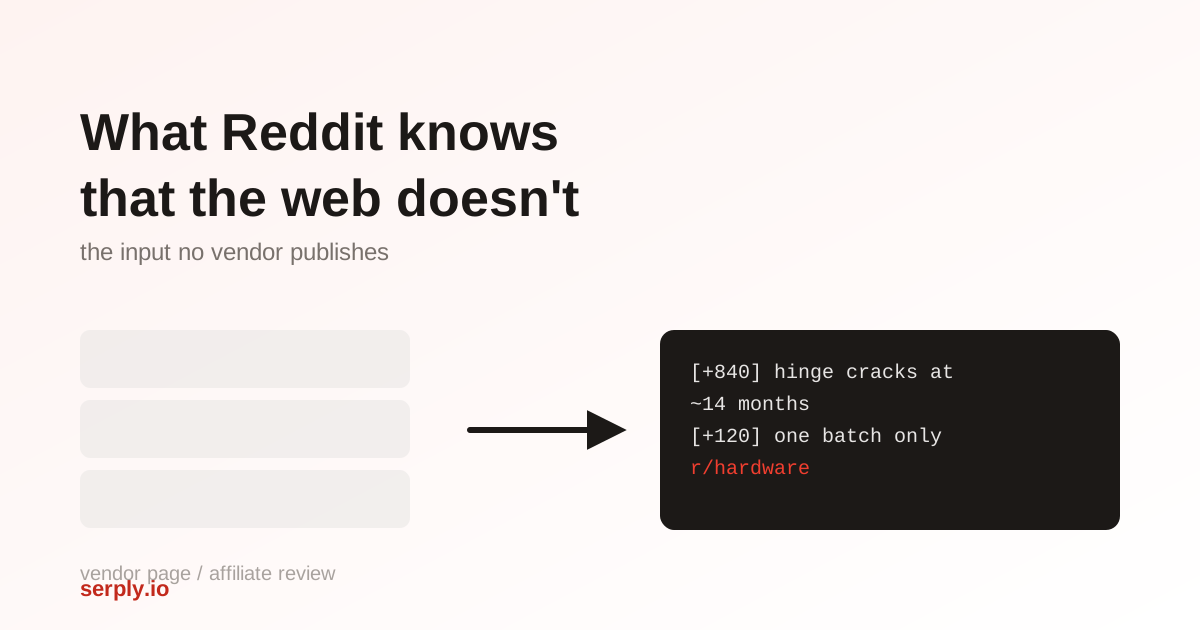
Every other source tells your agent what a product claims. Reddit tells it what happened to the people who bought one. That gap is why agents keep reaching for it.

- Why is Reddit data useful for AI agents?
- The shape of the data matters as much as the content
- The three access patterns agents actually need
- Where this goes wrong
- What it’s worth in practice
Ask an agent “is this laptop any good?” and give it a plain web search. It will come back with the manufacturer’s page, three affiliate review sites that are structurally incapable of saying no, and a spec comparison. All accurate. All useless.
Ask a human the same question and they’ll go find someone who actually owns one.
That’s the gap Reddit fills, and it’s why it keeps showing up in agent architectures that started out with search alone. This post is about what’s actually in that data, why it’s shaped differently from everything else your agent can reach, and what it costs to use it well.
Why is Reddit data useful for AI agents?
Because it contains the information that nobody has a commercial incentive to publish.
Think about what a product page can’t tell you. It can’t tell you the hinge cracks at fourteen months. It can’t tell you that support is unreachable on weekends, that the API rate limits are undocumented and lower than advertised, or that everyone in the field quietly switched to a competitor last spring. Those facts exist. They just only exist in places where the person writing has nothing to sell.
Reddit is the largest such place that is still text, still public, and still organized by topic. Google pays $60 million a year for access to it, which is a reasonable proxy for how much signal is in there.
Four categories of information show up on Reddit and essentially nowhere else:
Failure modes. Vendor docs describe the happy path. r/sysadmin describes what happens at 3am. If your agent is answering “what should I watch out for,” the entire answer lives in threads titled some variation of “PSA: don’t do what I did.”
Actual prices paid. List price is published. What people negotiated, what the renewal quote came in at, which tier is a trap — that’s forum knowledge.
Time-lagged verdicts. Reviews are written in week one. Reddit has the week-fifty-two thread, which is a different and much more useful document.
Vocabulary. How practitioners actually refer to a problem, which is rarely how the vendor names it. An agent that searches using marketing terminology finds marketing pages.
The shape of the data matters as much as the content
Here’s the part that makes Reddit unusually good input for a language model, as opposed to just a good place to read.
Most web pages are one voice asserting things. A Reddit thread is many voices arguing, with a crowd-sourced ranking applied on top. When a comment is wrong, the reply below it usually says so. When it’s right and non-obvious, it rises. You’re getting the claim and the peer review in the same payload.
That’s structurally close to what you want for grounding. An agent reading a vendor page has to decide whether to trust one assertion. An agent reading a thread can see that four people agreed, one disagreed with a specific counterexample, and the disagreement got more upvotes than the original.
LLMs tend to weight community consensus above marketing copy for exactly this reason — the disagreement is legible, and the ranking is a signal the model can read.
The score and reply-count fields carry real information, and they arrive as numbers you can filter on before anything hits the context window:
import os
import httpx

HEADERS = {"X-Api-Key": os.environ["SERPLY_API_KEY"]}


def subreddit(name: str, limit: int = 25, sort: str = "top", t: str = "year") -> list[dict]:
    r = httpx.get(
        f"https://api.serply.io/v1/reddit/subreddit/{name}",
        params={"limit": limit, "sort": sort, "t": t},
        headers=HEADERS,
        timeout=15.0,
    )
    r.raise_for_status()
    return [c["data"] for c in r.json()["data"]["children"]]


posts = subreddit("selfhosted", limit=50, sort="top", t="month")
worth_reading = [
    p for p in posts
    if p["score"] > 100 and p["num_comments"] > 20
]
Two filters and you’ve gone from fifty posts to the handful that a community of practitioners actually engaged with. There’s no equivalent filter for a page of search results — nothing in a SERP snippet tells you whether anyone found the page useful.
The three access patterns agents actually need
Serply’s Reddit endpoints map onto the three questions agents ask, and it’s worth knowing which is which because they cost different amounts of context.
“What is this community talking about?” — the subreddit listing. Cheap, broad, good for monitoring and discovery.
GET /v1/reddit/subreddit/{subreddit}?limit=25&sort=hot“What did people say about this specific thing?” — the comment thread. Expensive, deep, where the actual answers live.
GET /v1/reddit/comments/{id}?sort=confidenceIf it’s the post itself you’re after and not the discussion under it, GET /v1/reddit/post/{id} returns just that one post — body included, in Reddit’s own markdown — for the same single request. It costs a fraction of the context a full thread does, since none of it goes to comments you were going to discard.
“Is this person credible?” — user history. Narrow, and the one people forget exists.
GET /v1/reddit/user/{username}?limit=25&sort=newThat third one is underrated. When a single comment is carrying a lot of weight in your agent’s answer, pulling the author’s posting history tells you whether you’re reading a practitioner with two years of on-topic comments or an account that appeared last week to say nice things about one product. That check costs one request.
The responses come back in Reddit’s own listing shape — kind, data.after, data.children — passed through untouched, so anything that already parses Reddit JSON needs no adapter. The comments endpoint is the one exception: it returns { "cached": ..., "data": [post, comments] }, and the thread you want is in data[1].data.children. The post endpoint does that unwrapping for you and hands back the post object directly.
Where this goes wrong
Two failure modes, both worth designing against up front.
Reddit will not serve your agent. This is the practical blocker, and it hits before any of the above matters. Reddit aggressively blocks the exact traffic pattern an agent produces — non-browser user agents, bursty request timing, no session. You get login walls, 429s, and bot-check interstitials rather than data. We covered why your agent can’t read Reddit separately; the short version is that it’s not a bug you can fix with a user-agent header.
Reddit is not automatically true. A thread is evidence about what a self-selected group of people believe, which is not the same as evidence about the world. Popular does not mean correct, six-year-old advice about a fast-moving tool is often actively harmful, and coordinated promotion exists. Treating Reddit output as ground truth without any verification layer is a real way to make an agent confidently wrong — we go into the specific defenses here.
Neither of these is an argument against using it. They’re arguments for using it as one weighted input among several, which is how you should have been treating every source anyway.
What it’s worth in practice
The clearest case is any question where the honest answer is contested.
“Which of these two tools should we use” has no correct answer on either vendor’s site — both say themselves. It has a pretty good answer in a thread where forty people who’ve used both are arguing about it. Same for “is this worth the price,” “does this actually scale,” and “what breaks first.”
For an agent, the workflow is usually: search normally to establish the facts and the vocabulary, then hit Reddit for the verdict. Serply bills these the same way — one credit per successful uncached request, starting at $1.50 per 1,000 and dropping to $0.75 at volume, with Reddit responses cached for ten minutes and cached responses free. A monitoring agent polling the same subreddit every few minutes pays for a fraction of its calls.
The framing that’s held up best: search tells your agent what exists, and Reddit tells it what people found out afterwards. Most useful answers need both.
You can test the difference on your own questions with 2,500 free credits — enough to run a real comparison before deciding whether the Reddit half earns its place in your pipeline.