What Is GEO (Generative Engine Optimization) and How to Measure AI Visibility
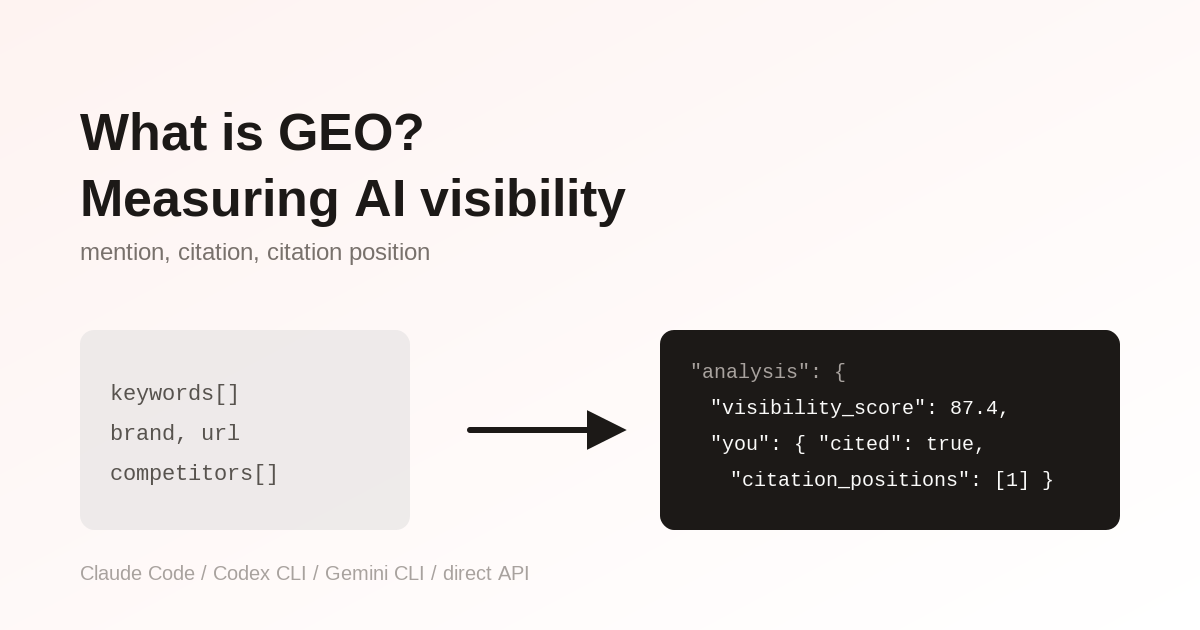
When the answer comes from an AI engine instead of a list of links, ranking is the wrong question. The right ones are: did it mention you, did it cite you, and where.

- What is generative engine optimization?
- Mention, citation, and citation position
- Why agent harnesses search differently than a plain API call
- How to measure AI visibility
- Tracking it with the Serply AI Visibility API (beta)
- Community sources are part of the answer
Search engine optimization had a clean scoreboard: a query, a results page, and your position on it. Generative engines broke that scoreboard. Ask an AI assistant “what’s the best tool for X?” and there is no page of ten blue links. There is one answer, a handful of sources, and either your name is in it or it isn’t.
Generative engine optimization (GEO) is the work of making sure it is. This post is about the part that has to come first: measuring it.
What is generative engine optimization?
GEO is optimizing for being included, accurately, in answers that AI engines write. The engine might be a chat assistant, an agent running a research task, or a coding assistant choosing a library. In every case the engine searches, reads some pages, and synthesizes. Your goal is to be in what it reads and in what it says.
Much of the work overlaps with SEO - useful pages, clear facts, a site that is easy to fetch. What is different is the measurement. You cannot read your “position” off an answer the way you read it off a results page, because the answer is prose and it changes from run to run.
Mention, citation, and citation position
Three signals do most of the work, and it is worth keeping them apart.
A mention is your brand or domain appearing in the answer text. It is the signal a reader notices: “Example is a good fit for this.” A mention early in the answer counts for more than one in a closing list of alternatives.
A citation is the answer linking to your site as a source. It is the signal that sends traffic and the one that says the engine trusted your page enough to rest a claim on it. You can be mentioned without being cited (the engine knows of you but sourced the claim elsewhere) and cited without being mentioned by name (your docs page backs a sentence about the category).
Citation position is where your citation sits among the sources, in the order the answer gives them. Position 1 is the source the answer leans on first. Position 6 is a footnote.
A useful fourth signal is presence in sources: whether your pages were among what the engine read at all, even if it ended up citing something else. If you are never in the sources, the problem is upstream of the answer - the engine’s searches are not finding you.
Why agent harnesses search differently than a plain API call
It is tempting to measure AI visibility with one API call to one model. That measures one thing: what that model, with one round of web search, says.
Agent harnesses behave differently. Claude Code, Codex CLI, and Gemini CLI run a loop: search, read a page, decide what is missing, search again, fetch another page, then answer. Along the way they issue more queries, phrase them differently, and read deeper into sites than a single call does. The sources an agent cites for the same keyword can be quite different from the sources a plain call cites.
That matters because more and more of the questions about tools and products are asked inside these harnesses - a developer asking their coding agent which API to use is asking a generative engine. Measuring only the plain call misses that audience.
There is a second axis: the search backend. Each engine ships with its own web search. Comparing engines on their own search tells you what their users see; comparing them on the same search index tells you how the engines differ when the inputs are equal. Both are useful questions.
How to measure AI visibility
A workable measurement loop looks like this:
- Pick keywords the way customers phrase them. “Best API for scraping Google results” rather than “SERP API”. Keep the list short and stable so week-over-week changes mean something.
- Run each keyword on several engines. A plain model call plus the agent harnesses your audience actually uses.
- Record mention, citation, citation position, and sources for you and for each competitor. Same answer, same signals, so the comparison is like for like.
- Keep the answers and the engine’s queries. When a score moves, the queries the engine ran and the sources it cited are usually the explanation.
- Repeat on a schedule. Answers vary from run to run, so a trend over weeks is more trustworthy than any single result.
Tracking it with the Serply AI Visibility API (beta)
The Serply AI Visibility API runs that loop as one request. You send up to five keywords, your site and brand, and up to five competitors, and choose the engines: a direct model API call, Claude Code, Codex CLI, Gemini CLI, or all of them. Each engine can use its own native search, or search through Serply so every engine reads the same index.
Each result comes back with the full answer, the queries the engine ran, every citation with its domain and position, and an analysis block: whether you were mentioned and cited, at which positions, how often you appeared in the sources, the same signals for each competitor, and a 0-100 visibility score. The score is deterministic - computed from those signals, not from another model’s opinion - so the same answer always gets the same score.
Because an agent run can take minutes, the API is asynchronous: start a job, then poll it. The hands-on tutorial walks through it in cURL and Python, and the reference docs list every field. The API is in beta, so fields may still change; you can try it in the playground first.
Community sources are part of the answer
One pattern stands out once you start reading citations: the sources are not just vendor sites. Reddit threads, Hacker News discussions, G2 reviews, and independent blog posts show up next to product pages, because engines go looking for what people say, not only what vendors claim.
That makes citations a map of where the conversation about your category happens. If a competitor keeps getting cited through the same community thread, that thread is shaping the answer. Being present - accurately and honestly - in the places engines read is a large part of GEO, and the citation list is how you find those places.